Malakh El
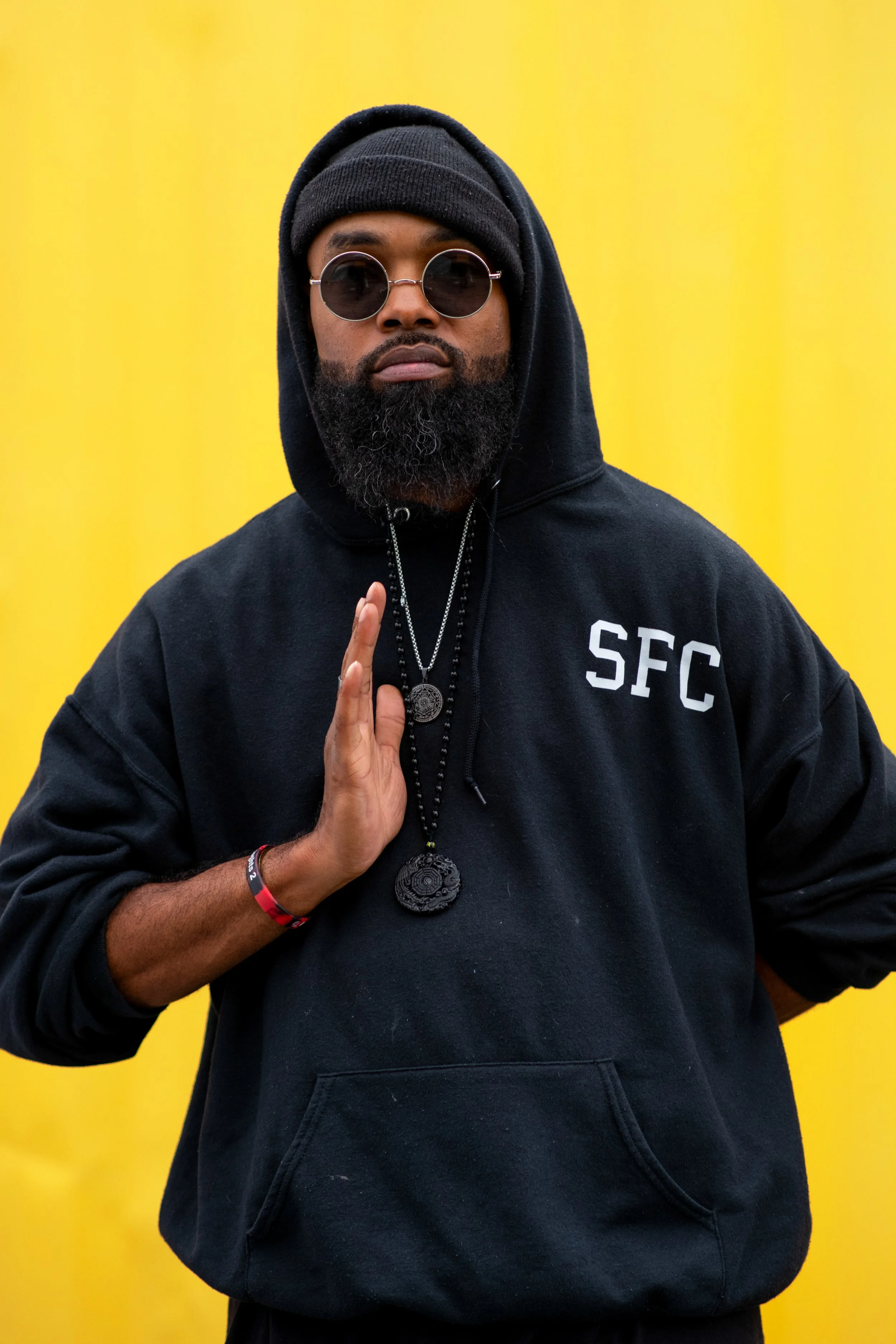
Few MCs embody Hip Hop’s fifth element—Knowledge—like Malakh El.
Malakh was raised on the South Side of Chicago, where chaos was commonplace. While violence swirled outside, Malakh escaped inward—into books, ideas, and the power of language. He devoured the dictionary for fun. His mother eventually enrolled him in military school, instilling structure and discipline. Around age 13, a family member introduced him to A Tribe Called Quest and taught him how to freestyle. The spark was lit—but his early rhymes, packed with philosophy and multisyllabic wordplay, were dismissed by peers who expected street talk. For a moment, he tried on other styles to fit in—until he discovered a different path.
That path opened wide when he “entered the 36 Chambers. ” The Wu-Tang Clan, especially Killah Priest and Killarmy, revealed a new blueprint: MCs who channeled spiritual knowledge through complex bars. From that point on, Hip Hop became a bootcamp for ministry. He studied religions, spiritual texts, and ancient philosophies like they were ammunition—filling his backpack with books and his mind with knowledge. By high school, he was skipping class to study religion and mysticism at the library. At 16, he prayed to become an angel. Two years later, during a study session, he told himself wherever his finger landed would be his new name. Finger pressed to page, he looked down: Malakh El, Hebrew for “messenger angel of the Most High. ”
While many chased clout, Malakh chased meaning. His lyricism—dense, elevated, and fiercely intentional—was often misunderstood in open mics and cyphers. Some accused him of spitting writtens because his freestyles were too polished and complex. “They didn’t say it was wack, ” he remembers, “they just didn’t know what I was talking about. ”
After relocating to Atlanta, he felt homesick for the cyphers that grounded him. That changed when he found Soul Food Cypher. From the beginning he recognized something different—an environment where MCs brought not just bars, but thought. Witnessing MC’s like Anon the Griot affirmed that there was space for his voice. But it was the relationships—those forged in everyday life—that transformed the cypher into a spiritual community and brotherhood. For Malakh, SFC became more than a creative outlet—it became a calling. Representing the cypher means bearing its name with honor, duty, and integrity.
Militant in mindset and priestly in posture, Malakh treats hip hop like a sacred discipline. He believes that the MC mirrors divine creation—just as God speaks the world into being, the MC builds reality in real time through the spoken word. His mission isn’t to entertain but to awaken. Every rhyme a ritual. Every word carries weight. “Wisdom brings responsibility, ” he says. “You don’t just speak to be heard. You speak to build. ” For Malakh, the cypher isn’t just an art form—it’s priesthood.
Step into the circle with him and you’ll feel it immediately. His multisyllabic rhyme schemes hit like scripture—ferocious in delivery, dense in meaning. His presence shifts the room. He’s not just rapping; he’s transporting you to new dimensions of thought, knowledge and wisdom. Because to Malakh El, Hip Hop isn’t merely a performance. It’s a sacred offering. A message from the Most High. Knowledge transformed into wisdom.